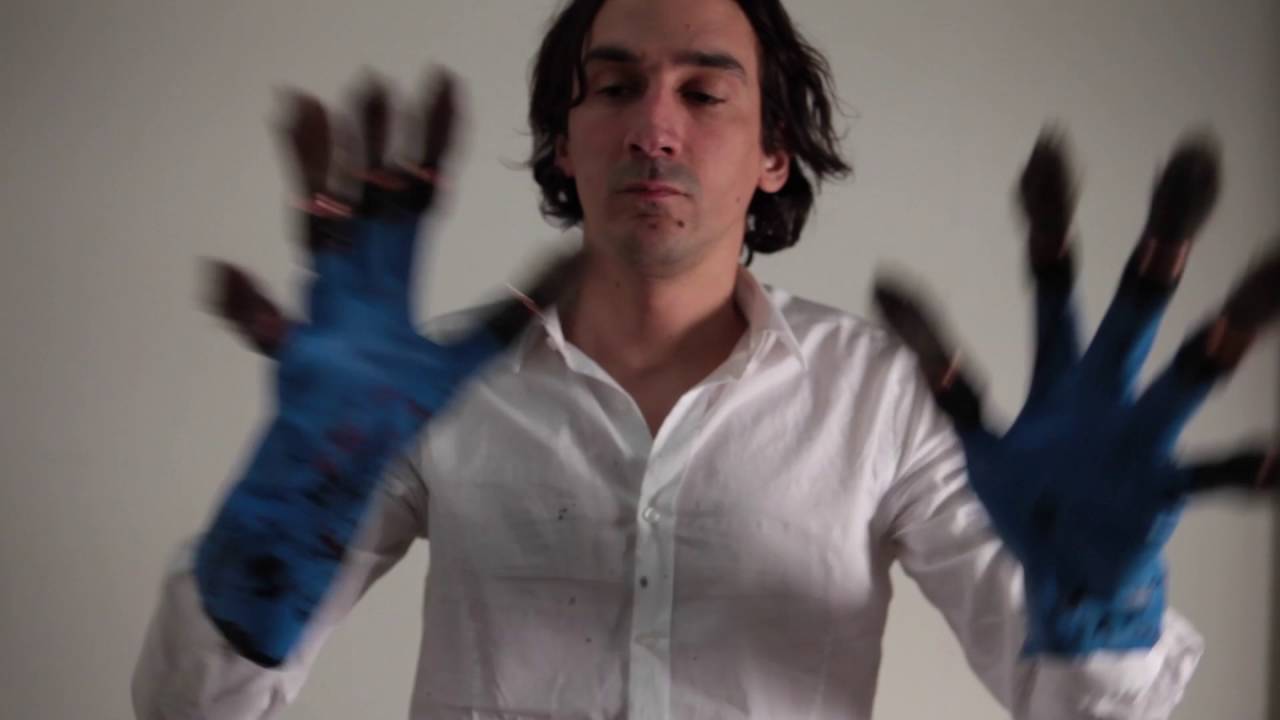
 The brush-gloves
Acrylic · Performance
The Art of Speech
What if the great orators held brushes while they spoke? I learn their gestures by heart, then replay them facing the canvas, to the sound of their voices. Only the marks remain, and they are enough: without knowing who spoke, you can tell the man of peace from the dictator.
The protocol
The idea began with a question: what if politicians held brushes while they spoke? Then with a personal experience, a period when I could no longer speak, and when I measured everything the hand says in place of the voice. So the work starts with pantomime: I learn a speech's gestures by heart, then replay them in front of the canvas, to the sound of the words. Every canvas is square, after Vitruvian Man, in whom the span of the arms equals the height of the body: each canvas is the exact height of the man speaking. Nor are the colours free: each palette is borrowed from the speaker's own symbolism.
The brush-gloves
The tool did not exist, so it had to be made: ten brushes fixed to the fingers of the gloves. The whole hand paints, the arm follows, and so does the body. Nothing is left between the gesture and the canvas.
The brush-gloves
Charles de Gaulle
Albert Hall, London, 1942. Grandeur, solitude, absolute certainty. The blue and the red come from the Cross of Lorraine, red on a blue ground in its early days. The canvas absorbs the energy of a man addressing a nation from exile.

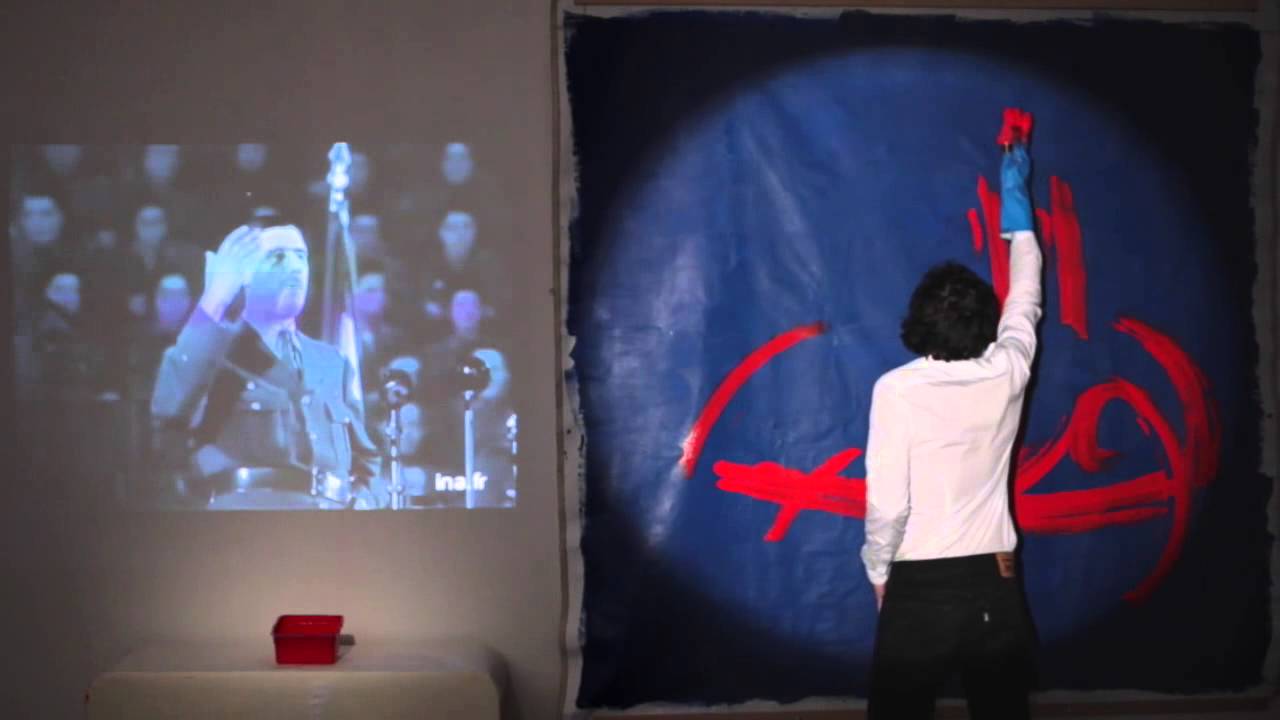 De Gaulle, Albert Hall
Martin Luther King
"I have a dream." Washington, 1963. Glossy black on matte black: the gesture appears only where the light grazes it. The black pastor who brought the cause of Black people into the light, on a canvas that has to be lit to be seen.

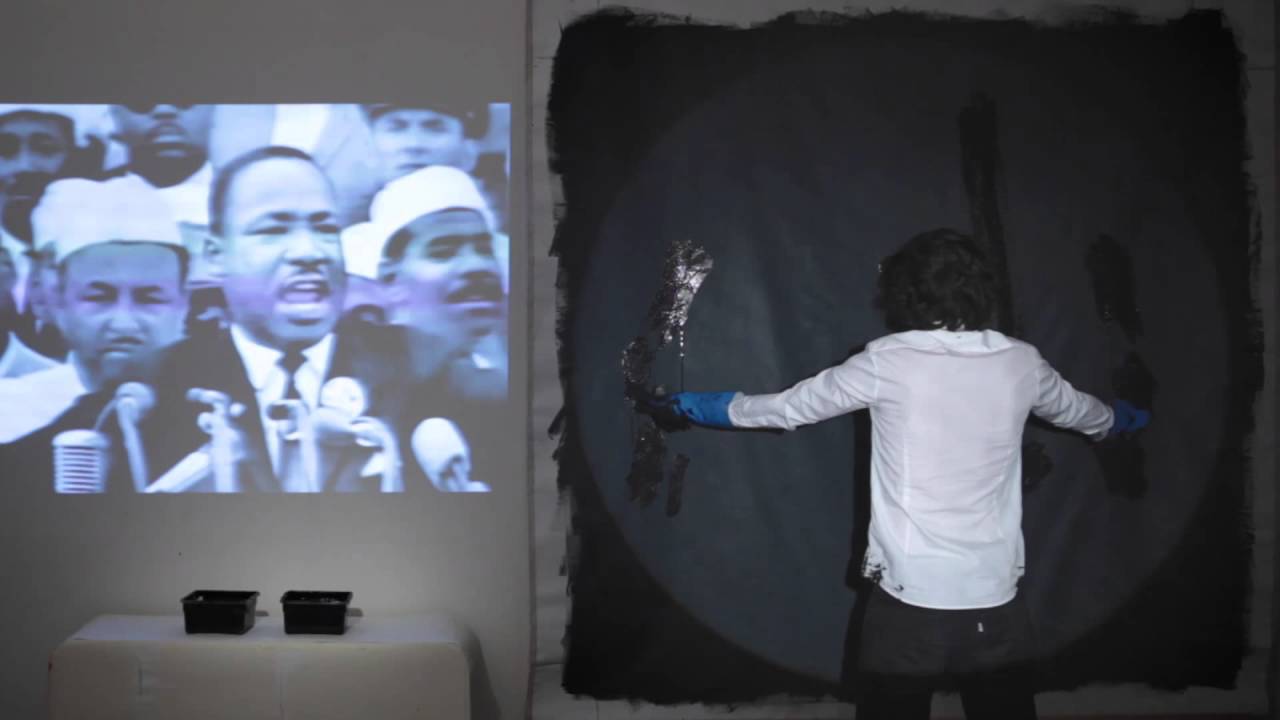 MLK, I have a dream
Adolf Hitler
The mechanics of hatred. A speech that grinds, galvanises, destroys. One colour only here, blood red, the colour of what those words finally produced. Jarring gestures, crushed paint.

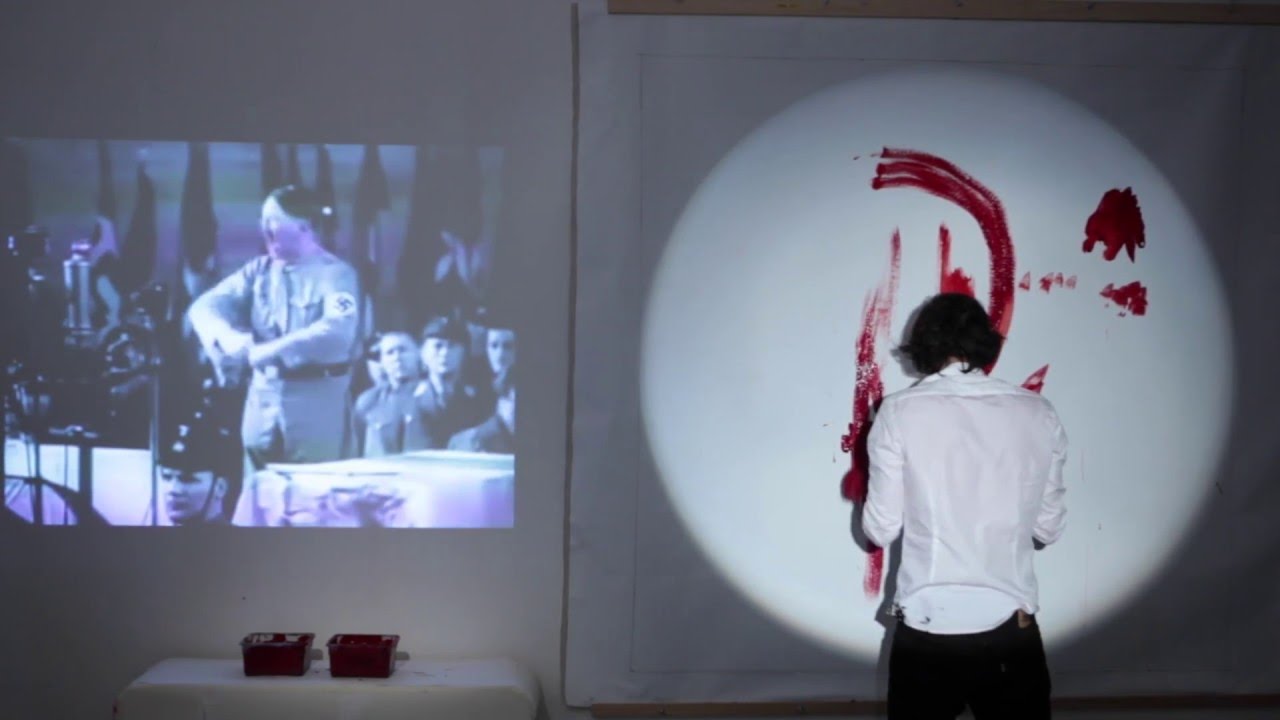 Hitler, Nuremberg
The next speeches
The series continues. Next encounters with the spoken word:
- Barack ObamaA More Perfect Union, Philadelphia, 2008
- Nelson MandelaSpeech on his release, Cape Town, 1990
- Robert BadinterThe abolition of the death penalty, French National Assembly, 1981
- Jean-Paul IIHabemus papam, St Peter's Square, 1978
- John F. KennedyWe choose to go to the Moon, Rice University, Houston, 1962
- Fidel CastroAddress to the United Nations, New York, 1960
- Winston ChurchillTwo wartime speeches, House of Commons, 1940
- …The list stays open
Next step
Taking the project on stage: painting the canvas live in front of an audience, the speech playing in the room. What was filmed in the studio would become a performance, where gesture and words move at the same pace, with no second take.
Without a word
The brush-gloves were invented for speech. They do not need it. A conductor conducts Debussy's La Mer, and his gestures alone guide the brush. The three symphonic sketches give three canvases: from dawn to noon on the sea, play of the waves, dialogue of the wind and the sea. A triptych, like the sunsets.
Without a gesture
At the other extreme, Gandhi. No gesture, no colour: a white canvas cut from khadi, the hand-spun, hand-woven cotton. Gandhi asked Indians to make their own clothes rather than let England carry off the cotton; the wheel at the centre of the Indian flag keeps its memory. Here the speech is not painted, it is in the canvas.